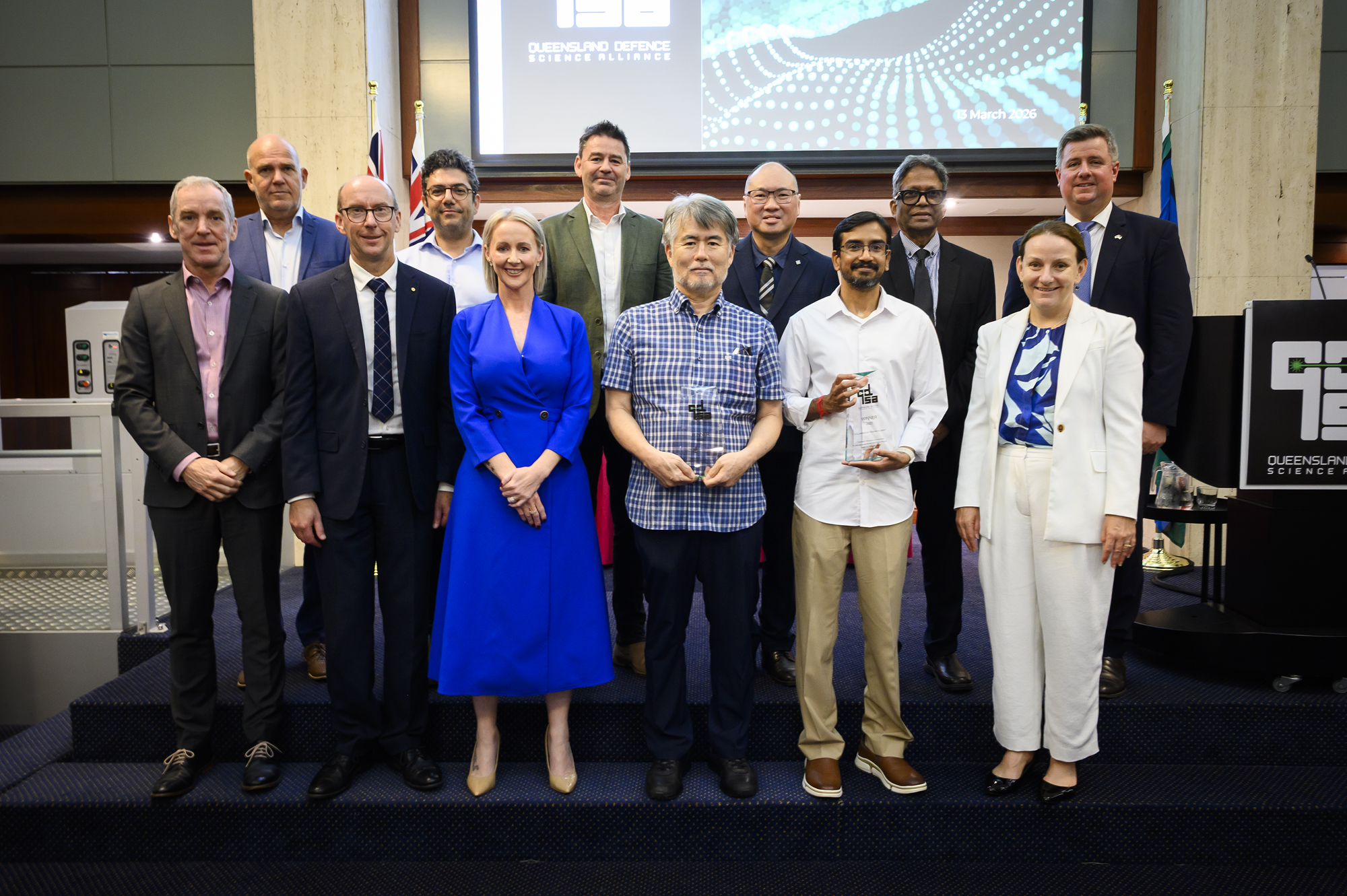
The Queensland Defence Science Alliance (QDSA) has announced three cutting-edge Defence projects as the recipients of the highly sought-after 2025 QDSA Collaborative Research Grants (CRG), injecting significant investment into Queensland and the Northern Territory economies and strengthening Australia’s sovereign Defence capabilities.
Now in its fourth year, the CRG program has to date injected a total of $7.68 million into the Queensland economy — a testament to the program’s growing impact and the strength of collaboration between universities, industry, and Defence.
“These winning projects represent a unique opportunity to accelerate research and industry collaboration for a shared purpose,” said QDSA Director Stuart Blackwell.
“The quality of submissions we received this year was outstanding, and these three projects demonstrate exactly the kind of high-quality, proof-of-concept work that can accelerate the leap from innovative concepts to prototypes with impact for Defence.”
The 2025 CRG program was themed around Littoral Operations, identified through wide consultation with Defence stakeholders and a thorough review of the 2024 Defence Innovation, Science and Technology (IS&T) Priorities, the National Defence Strategy, and the Integrated Investment Program.
Research topics spanned Intelligence, Surveillance and Reconnaissance (ISR), Command and Control, Cyber Operations, and Logistics — all critical to supporting Australia’s operational capability in contested coastal environments.
Each project must be led by a QDSA member university — Griffith University, James Cook University, the University of Queensland, Charles Darwin University, University of Sunshine Coast or University of Southern Queensland — and supported by co-investment from Defence industry partners, ensuring projects are not only academically rigorous but primed for transition to capability.
“Co-investment from industry partners is central to leveraging the funding available within this program,” Mr Blackwell said.
“It ensures we are selecting projects with the strongest possible pathway from the laboratory to the field.”
“The intent is to accelerate emerging research to a level of maturity where a demonstration can be provided for further development into a Defence capability through subsequent funding provided by follow-on grants or through Defence Industry pathways.”
The 2025 winning projects are:
SPACEFRAME-BASED FLOATING BRIDGE: This project addresses the growing demand for floating bridges with integrated ferry capabilities, proposing a novel construction method based on modular spaceframe structures. When adapted for floating applications, these three-dimensional frameworks can be compactly stored and transported, flexibly assembled, and rapidly disassembled either on land or directly on water.
The 18-month project will advance key components, including structural slabs, quick-release coupling adapters, and buoyancy modules, to reach Technology Readiness Level 5 and prepare the system for prototype testing and certification.
Led by Griffith University, in partnership with the University of Queensland and Fusion Plastics.
CORROSION BEHAVIOUR OF ADDITIVELY MANUFACTURED NICKEL ALUMINIUM BRONZE (NAB) FOR RELIABLE LITTORAL PROPULSION SYSTEMS: Nickel aluminium bronze is a critical alloy for naval propulsion systems, valued for its corrosion resistance, strength, and antifouling properties. Traditional casting of NAB components is slow, logistically difficult, and increasingly constrained in Australia. This project leverages SPEE3D’s cold spray additive manufacturing (CSAM) process — a sovereign, deployable method — to produce NAB components in near-net-shape with minimal post-processing. The research will conduct novel corrosion investigation of NAB alloys in simulated, Defence-relevant littoral environments where salinity, cavitation, and microbial activity converge.
Led by Charles Darwin University, in partnership with James Cook University, SPEE3D, and the Australian Institute of Marine Sciences.
AEGISLITTORAL: AI-ENHANCED HYPERSPECTRAL ISR SYSTEM FOR SUBSURFACE AND SURFACE THREAT DETECTION IN CONTESTED COASTAL ZONES: AegisLittoral is a next-generation, modular Intelligence, Surveillance, and Reconnaissance (ISR) system that leverages AI-enhanced hyperspectral sensing for real-time detection and classification of surface and subsurface threats in littoral and contested coastal environments. The system integrates hyperspectral imaging, machine learning, and physics-based spectral modelling to detect concealed, camouflaged, or submerged threats — including IEDs, mines, and illicit containers — even under turbid water or vegetation cover.
Designed for deployment across multiple portable platforms, including uncrewed and autonomous vehicles and handheld units, AegisLittoral operates autonomously in GPS-denied or communications-degraded zones using edge AI processing on low-power neural processing units.
Led by Griffith University, in partnership with the University of the Sunshine Coast, EPE: Trusted to Protect, Astute Systems, and Korea Aerospace Research Institute (KARI).
“What excites me most about this year’s cohort is the diversity of capability on display, from innovative engineering for logistics to advanced manufacturing and materials science to AI-enhanced surveillance systems”,” Mr Blackwell said.
“Each project directly addresses real operational challenges for Defence personnel in littoral environments, and each has a clear and credible pathway to capability. This is exactly what the CRG program was designed to deliver,” he said.
The Queensland Government, through the Department of Environment, Tourism, Science and Innovation (DETSI) and the Department of State Development, Infrastructure, and Planning (DSDIP), proudly partners with the Defence Science and Technology Group (DSTG) and the six QDSA member universities to invest in Australia’s Defence innovation ecosystem. This collaboration aims to accelerate innovation and excellence in Defence research and to grow sovereign capability across Northern Australia.
“Our goal has always been to provide investment dollars that help accelerate a pull-through of technology from research to industry where a demonstration can be provided for further development,” Mr Blackwell said.
“Now in its fourth year, the CRG program continues to grow in strength, bringing together six university members to collaborate on innovative solutions to Defence challenges across northern Australia.”
Further information about the 2025 QDSA Collaborative Research Grants can be found at qdsa.au.
#ENDS#
For media enquiries, please contact:
info@qdsa.com.au